How to Use Equity Curve Regime Filtering to Avoid Cold Streaks
A seasonal pattern with an 80% win rate can still lose money for years at a time. Equity curve regime filtering tells you whether a pattern is working right now— so you put your capital where it counts.
The Problem With Historical Win Rates
Most seasonal analysis stops at the historical win rate. A pattern that was profitable in 20 out of 25 years gets an 80% win rate label, and traders assume that means it will probably work this year too.
But that 80% is an average across a quarter century. It hides the fact that seasonal patterns go through streaks — periods where they win consistently, and periods where they fail repeatedly. A pattern might win 8 years in a row, then lose 3 out of 4, then come back strong again. The 25-year win rate stays the same through all of it.
If you trade a pattern during one of its cold streaks, you lose money — even though the historical statistics look strong. The question isn't whether a pattern has worked in the past. The question is: is it working now?
What Is Equity Curve Regime Filtering?
Equity curve regime filtering is a technique that classifies a seasonal pattern as HOT, COLD, or NEUTRAL based on its recent performance. Instead of looking at the full 25-year average, it looks at what the pattern has done in its most recent trades.
Think of it like a moving average on the pattern itself. Just as traders use moving averages to identify whether a stock is in an uptrend or downtrend, regime filtering identifies whether a seasonal pattern is in a winning phase or a losing phase.
HOT
The pattern is in a winning streak. Recent win rate is 60% or higher with positive compounded returns. This is when you want your capital deployed.
COLD
The pattern is in a losing phase. Recent win rate is 40% or lower with negative returns. Step aside and wait for the regime to turn.
NEUTRAL
Neither clearly winning nor losing. The pattern is between phases. Proceed with caution or wait for a clearer signal.
How Regime Detection Works
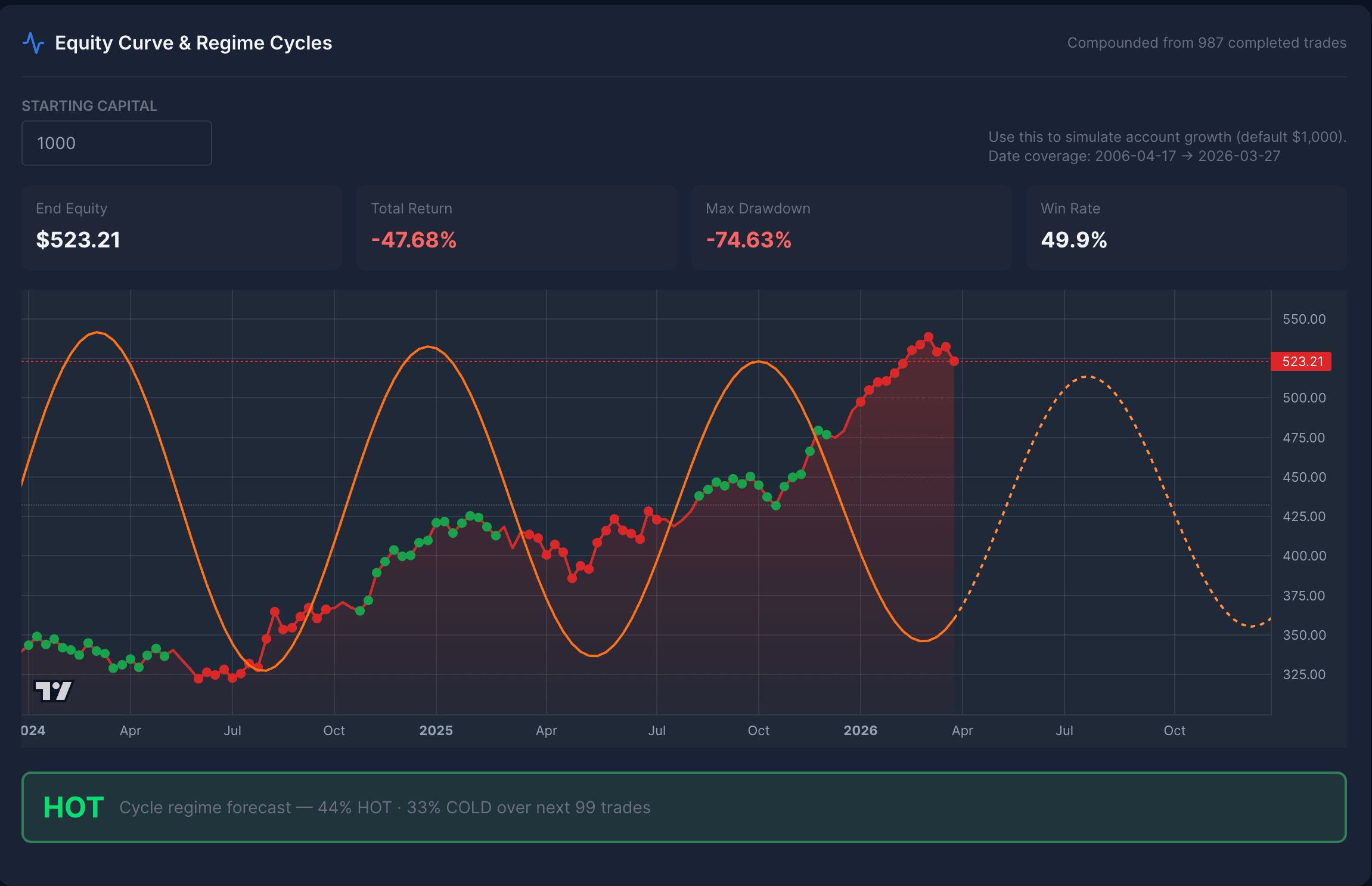
The algorithm slides a rolling window across the pattern's equity curve — the cumulative profit/loss from trading the pattern every year. At each point, it calculates the win rate and compounded return within that window.
Step 1: Build the equity curve
Start with $1,000 of hypothetical capital. For each year the pattern occurred, apply the actual return. After 25 years, you have a complete equity curve showing how $1,000 would have grown (or shrunk) by trading this pattern every time it appeared.
Step 2: Slide the window
Take the last 8 trades (the rolling window). Calculate the win rate within those 8 trades and the compounded return. If 6 out of 8 won and the compounded return is positive, the current regime is HOT. If only 3 out of 8 won and the return is negative, it's COLD.
Step 3: Identify phases
Consecutive HOT or COLD data points are grouped into phases. A phase must span at least 3 trades to count — this prevents single-trade noise from triggering false regime changes. The result is a clear map of when the pattern was working and when it wasn't.
Why This Is Really About Capital Allocation
Your trading capital is not unlimited. Every dollar you allocate to a seasonal pattern that's in a cold streak is a dollar that's not working in a pattern that's currently hot.
This is the real insight behind regime filtering. It's not just about avoiding losses — it's about making the most of the money you have. If you have $50,000 to trade, you want every dollar deployed in the highest-probability setups available right now. A seasonal pattern with a 100% historical win rate that's currently in a HOTregime is one of the best places your capital can be — far better than parking it in slow-moving assets while you wait for a cold pattern to turn around.
Without regime filtering, you spread your capital evenly across all patterns that look good historically. Some of those patterns are currently winning. Some are currently losing. Your capital is diluted. With regime filtering, you concentrate your capital on the patterns that are working right now— the ones most likely to keep winning in the near term.
Think of it as a portfolio filter
You wouldn't buy a stock in a downtrend and hope it reverses. The same logic applies to seasonal patterns. A pattern in a COLD regime is in a downtrend. A pattern in a HOT regime is in an uptrend. Regime filtering lets you ride the winners and sit out the losers — keeping your limited capital in the trades that are actually producing returns.
The Numbers: -8% vs +128%
Here is a real comparison across hundreds of seasonal patterns. Same universe of patterns, same market, same time period. The only difference is whether you filter by equity curve regime.
| Filter | Trades | Win rate | Avg return | Total return | End equity |
|---|---|---|---|---|---|
| All trades (no filter) | 505 | 51.3% | -0.02% | -8.78% | $803 |
| EC HOT only | 143 | 71.3% | +0.43% | +128.78% | $3,444 |
Trading everything lost money. Filtering to HOTregime patterns only turned $1,000 into $3,444 — using fewer trades, with a higher win rate, and far less capital at risk at any given time.

Notice the trade count: 505 unfiltered vs. 143 with the HOT filter. You're not just making more money — you're making it with 72% fewer trades. That means less time in the market, less exposure to unexpected events, and more capital available for the setups that matter.
When to Trade and When to Sit Out
Regime filtering changes how you think about seasonal setups. Instead of “this pattern has a good win rate, I'll trade it,” the decision becomes:
Pattern is HOT— trade it
The pattern is currently in a winning phase. Historical edge + current momentum = highest probability. Allocate capital here.
Pattern is COLD— skip it
The pattern is in a losing streak. Even if the 25-year stats look great, right now it's not working. Keep your capital for better opportunities.
Pattern is NEUTRAL— reduce size or wait
The pattern is between phases. If you trade, use a smaller position. Or wait for the regime to turn HOT before committing capital.
The mental shift: Without regime filtering, sitting out feels like missing an opportunity. With it, sitting out isthe strategy. You're not doing nothing — you're protecting capital for the next high-probability setup.
Common Objections
“Doesn't this just reduce the number of trades?”
Yes — that's the point. Fewer, higher-quality trades. The data shows 143 HOT-filtered trades produced 16x the returns of 505 unfiltered trades. More trades is not better if the extra trades are losers.
“What if the regime changes mid-trade?”
Regime is assessed before entry, not during. The regime tells you whether to enter the trade. Once you're in, manage the trade with your stop-loss and take-profit targets as usual.
“Isn't this just curve fitting?”
Curve fitting means optimizing parameters to match past data. Regime filtering uses a simple, fixed rule: is the recent win rate above or below a threshold? The thresholds (60% for HOT, 40% for COLD) are not optimized per pattern — they're applied universally. The approach is no more curve-fitted than using a moving average to determine trend direction.
How to Use Regime Filtering in Practice
If you're screening seasonal patterns manually, adding regime filtering requires building an equity curve for each pattern and running cycle detection on it. That's feasible for a handful of patterns but doesn't scale across thousands of securities.
Seasonal Edge runs regime detection automatically on every seasonal pattern in its database. In the screener, you can filter by regime with one click — showing only HOT patterns, only COLDones, or any combination. Every pattern detail view includes the full equity curve with regime overlay, so you can see exactly where the current moment falls in the pattern's cycle.
The practical workflow is simple: open the screener, filter for patterns entering in the next 7 days, set regime to HOT, and sort by composite score. The top results are your highest- conviction seasonal setups with current momentum behind them.
Frequently Asked Questions
What is equity curve regime filtering?
It's a technique that classifies a seasonal pattern as HOT, COLD, or NEUTRAL based on its recent performance. Instead of blindly trading every occurrence, you only trade when the pattern is in a HOT regime — a winning streak with positive momentum.
How does the detection algorithm work?
A rolling window (8 trades) slides across the equity curve. At each point, it calculates win rate and compounded return. 60%+ win rate with positive return = HOT. 40% or lower with negative return = COLD. Everything else = NEUTRAL. Consecutive points of the same type are grouped into phases.
Why not just trade high win rate patterns?
Even patterns with 80%+ historical win rates go through multi-year cold streaks. An 80% win rate over 25 years can include a 3-year stretch of mostly losses. Regime filtering catches these cold streaks in real time.
Can I apply this to non-seasonal strategies?
Yes. Equity curve regime analysis works on any strategy with a trade history. The concept — evaluating whether a strategy is currently in a winning or losing phase — applies to technical trading systems, mean reversion strategies, and anything else with a measurable equity curve.
Filter for HOT Seasonal Patterns Today
Seasonal Edge screens 4,500+ securities and ranks every pattern by equity curve regime, win rate, and efficiency. One click to see only the patterns with current momentum behind them.
Free preview includes AAPL, NVDA, and TSLA. 50% off for early adopters. Cancel anytime.