What Is Seasonal Trading? A Data-Driven Guide
How recurring price patterns work, how to evaluate them, and why some of the most well-known seasonal tendencies have persisted for decades.
Seasonal trading is a strategy that exploits recurring price tendencies in financial markets — patterns where a stock, index, or futures contract historically rises or falls during specific calendar periods.
The idea behind seasonal trading is straightforward: certain forces — earnings cycles, tax-loss harvesting, fund rebalancing, agricultural supply chains, consumer spending patterns, and even weather — create predictable demand shifts at specific times of year. When these forces repeat consistently enough, they produce tradeable patterns.
Unlike technical analysis (which reads chart patterns) or fundamental analysis (which values companies), seasonal analysis asks a simpler question: what has this security done at this time of year, historically?
How Seasonal Patterns Work
A seasonal pattern is defined by a specific entry date, exit date, and direction (long or short) — but that alone isn't enough to take a trade. You also need a stop-loss (based on the pattern's historical maximum drawdown) and a take-profit target (based on its historical maximum gain). Entry, exit, take-profit, and stop-loss — all four are required before putting capital at risk. For example: “Buy the S&P 500 on November 1, sell on April 30, stop at -3%, target +10%.” To determine whether this is a real pattern or noise, you test it against every year in the dataset.
If the S&P 500 rose during that window in 19 out of 25 years, that's a 76% win rate. If the average gain was 7.2% over 181 days, that gives you a clear expectation of risk and reward. The more years it works, the more likely the pattern reflects a real structural tendency rather than random chance.
What Drives Seasonal Patterns
Institutional flows
Fund rebalancing at quarter-end, pension fund contributions in January, window dressing before reporting periods. These create predictable buying and selling pressure.
Tax-driven selling
Tax-loss harvesting in October-December depresses losing stocks. The “January effect” reversal occurs when that selling pressure lifts.
Earnings cycles
Stocks in the same sector tend to report earnings in the same weeks each quarter, creating recurring volatility windows.
Recurring events
Annual conferences, policy meetings, and industry events create anticipatory buying and selling. The Munich Security Conference every February drives defense stocks higher in January; OPEC meetings move oil prices; central bank rate decisions create predictable volatility windows.
Commodity supply cycles
Agricultural commodities follow planting and harvest seasons. Natural gas peaks with winter heating demand. These physical supply constraints create some of the strongest seasonal patterns.
Seasonal vs. cyclical
Seasonal patterns are tied to the calendar — the same dates each year. Cyclical patterns repeat at variable intervals based on economic or astronomical cycles. Seasonal Edge analyzes both: calendar-based seasonal patterns and cycle-based patterns such as planetary harmonics and Mercury cycle alignment.
Well-Known Seasonal Patterns
Some seasonal tendencies are so well-established that they have names. Here are the most widely cited, along with the data behind them.
1. “Sell in May and Go Away”
The most famous seasonal pattern in equity markets. The full adage is “Sell in May and go away, come back on St. Leger's Day” (a September horse race in the UK). In practice, it refers to the tendency for stocks to underperform from May through October relative to November through April.
| Period | S&P 500 avg. return (1950–2025) | Win rate |
|---|---|---|
| Nov – Apr | ~7% | ~77% |
| May – Oct | ~2% | ~65% |
Source: Bouman & Jacobsen, “The Halloween Indicator, 'Sell in May and Go Away': Everywhere and All the Time,” American Economic Review, 2002. Confirmed across 37 countries. Updated estimates based on S&P 500 data through 2025.
2. The Santa Claus Rally
Coined by Yale Hirsch in the 1972 Stock Trader's Almanac, the Santa Claus Rally refers to the tendency for stocks to rise during the last five trading days of December and the first two trading days of January. Since 1950, the S&P 500 has gained an average of approximately 1.3% during this seven-day window, with a positive return roughly 75% of the time.
Possible drivers include year-end tax positioning, holiday optimism, low institutional volume (which amplifies buying pressure from retail investors), and new-year fund inflows.
Real Example: Rheinmetall's January Rally
Rheinmetall AG (RHM.DE), Europe's largest defense contractor, shows one of the clearest event-driven seasonal patterns in the market. Every February, the Munich Security Conference brings defense spending into the headlines. The anticipation starts in January — and the data shows it.
A long position entered January 3 and exited January 22 has been profitable in 10 out of 11 years — a 90.9% win rate with an average gain of +7.5% and a maximum win of +16.6%. The single losing year saw just a -2.2% drawdown.
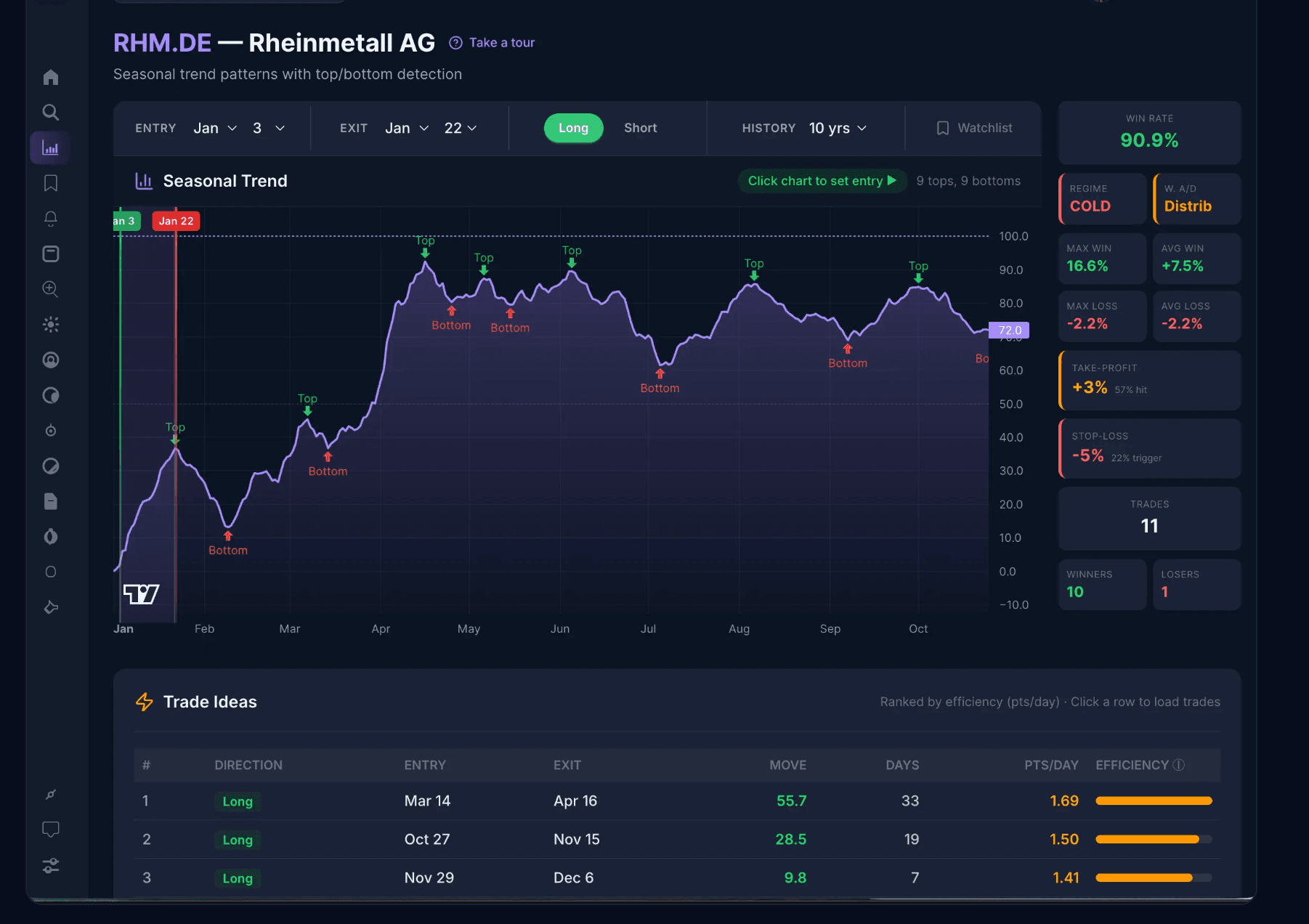
Why does this pattern exist? The Munich Security Conference (typically held in mid-February) is the world's largest gathering of defense and foreign policy leaders. In the weeks leading up to it, media coverage of defense budgets, NATO commitments, and geopolitical tensions intensifies — driving institutional and retail buying in defense names. The pattern reflects anticipatory positioning ahead of the event.
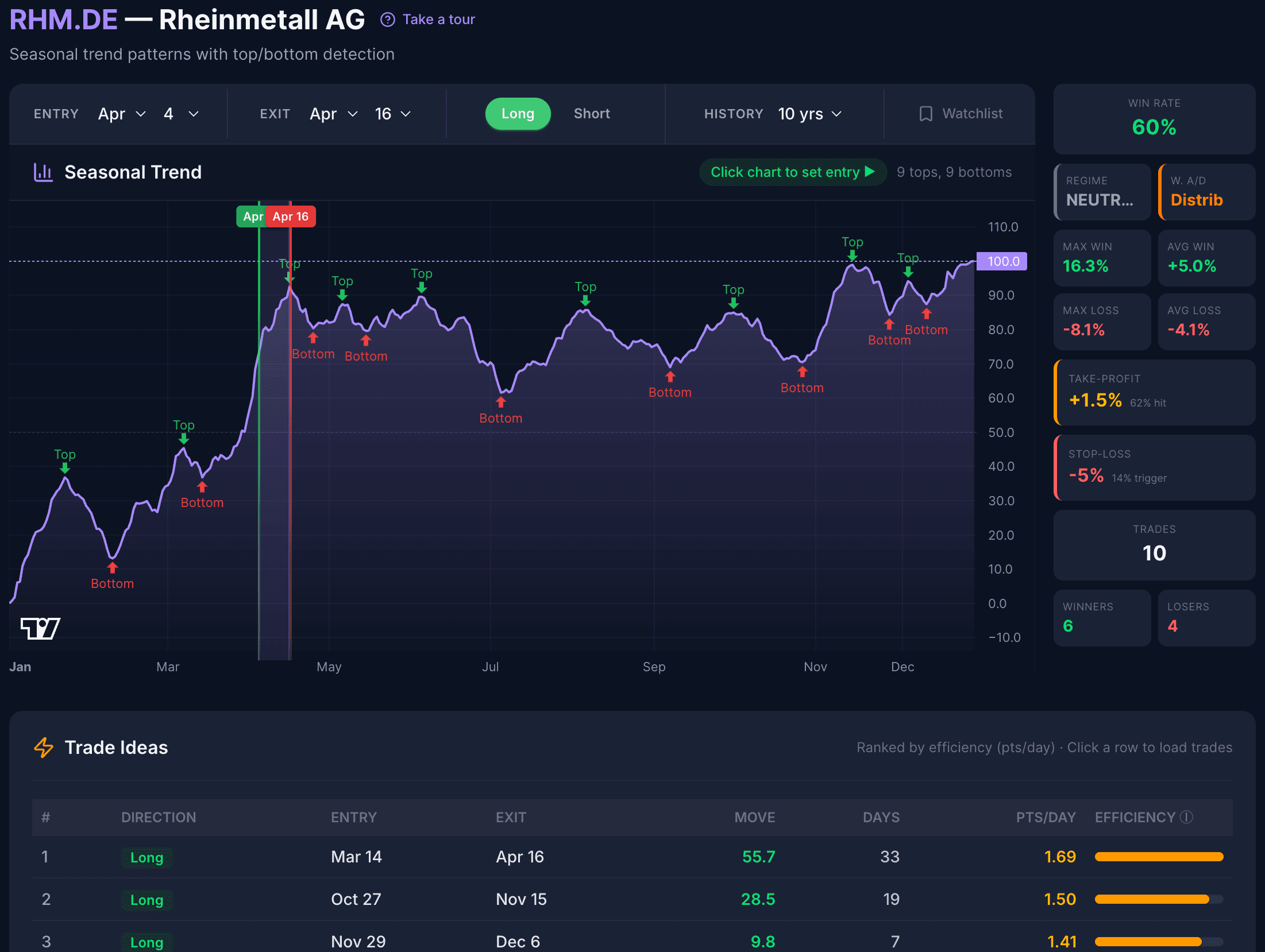
Later in the year, a second seasonal window appears around budget season (March 14 – April 16), though with a lower 60% win rate:
Why this example matters
Rheinmetall's January pattern illustrates the ideal seasonal setup: a clear fundamental driver (Munich Security Conference), a high win rate (90.9%), a meaningful sample size (11 years), and asymmetric risk/reward (7.5% average gain vs. 2.2% max loss). This is the kind of pattern that systematic seasonal screening surfaces automatically from thousands of securities.
These are broad tendencies, not guarantees. Every pattern should be evaluated on its own statistical merits — win rate, sample size, efficiency, and current regime — before trading.
How to Evaluate a Seasonal Pattern
Not every seasonal pattern is worth trading. A pattern that shows up once in a chart might be coincidence. Here are the four metrics that separate signal from noise.
1. Win Rate (minimum 70% over 15+ years)
The percentage of years the pattern produced a profitable trade. A pattern with an 80% win rate over 25 years means 20 out of 25 occurrences were winners. Higher is better, but context matters — a 70% win rate with large average gains can outperform a 90% win rate with tiny gains.
Threshold: Below 60% win rate, the pattern is unlikely to represent a structural tendency. Above 80% with 20+ years of data is strong evidence.
2. Sample Size (minimum 10 years)
A 100% win rate over 5 years is only 5 trades — not enough to be confident. A 75% win rate over 25 years is 18-19 wins out of 25 — much more meaningful. More data reduces the probability that the pattern is a statistical fluke.
Threshold: 10 years is the minimum. 20+ years provides high confidence that the pattern reflects a real market tendency rather than an artifact of a specific regime.
3. Efficiency (average daily return)
Efficiency measures the average daily price move during the pattern window. A pattern that gains 3% in 5 days (0.6%/day) is more capital-efficient than one that gains 10% in 100 days (0.1%/day). High-efficiency patterns let you compound more trades per year with less capital tied up.
Why it matters: Two patterns might have the same win rate, but the one with higher efficiency produces better risk-adjusted returns because your capital is exposed for fewer days.
4. Equity Curve Regime (HOT / COLD / NEUTRAL)
Historical win rates tell you what happened over 25 years. Equity curve regime analysis tells you what's happening now. By running cycle detection on a pattern's equity curve, you can identify whether it's currently in a HOT (winning streak, uptrending equity curve), COLD (losing phase, downtrending), or NEUTRAL phase.
Why it matters: A pattern with an 80% historical win rate can still go through multi-year cold streaks. Trading only during HOT regimes dramatically improves actual returns. In our screener walkthrough, filtering by EC HOT turned a losing strategy into +128% returns.
Seasonal Trading vs. Other Approaches
| Approach | What it analyzes | Time horizon | Best for |
|---|---|---|---|
| Seasonal trading | Calendar-based price tendencies | Days to months | Swing traders, position traders |
| Technical analysis | Price action, volume, indicators | Minutes to months | Day traders, swing traders |
| Fundamental analysis | Company financials, valuation | Months to years | Long-term investors |
| Cycle analysis | Astronomical and economic cycles | Days to years | Cycle traders, astro traders |
These approaches are complementary, not mutually exclusive. Many traders use seasonal analysis to identify when to look for trades, then use technical analysis to time entries and exits.
Common Mistakes in Seasonal Trading
Trading patterns with too few data points
A pattern that worked for 5 consecutive years could easily be coincidence. Demand at least 10 years of data, and prefer 20+.
Ignoring the equity curve regime
A pattern's 25-year average win rate masks the fact that it may be in a cold phase right now. Always check whether the equity curve is trending up or down before entering.
Cherry-picking one strong year
A single year where the pattern returned 20% doesn't validate the pattern. Look at the distribution of returns across all years, including the worst.
Overfitting to noise
If you screen thousands of securities, some will show “patterns” by pure chance. Guard against this by requiring high win rates over long time periods and checking whether the pattern has a plausible fundamental driver.
No risk management
Seasonal patterns define timing, not position sizing. Use historical average loss and maximum drawdown data to set stop-losses and determine appropriate position sizes.
From Manual Research to Systematic Screening
Historically, seasonal analysis meant downloading price data into spreadsheets and manually calculating averages for each calendar window. This is feasible for a handful of symbols but doesn't scale. With 4,500+ securities and dozens of potential patterns per symbol, the number of combinations quickly reaches millions.
Modern seasonal screening platforms automate this process. They detect seasonal tops and bottoms using directional change algorithms across 25+ years of data, filter by win rate and efficiency, rank patterns by a composite score, and present results in a forward- looking calendar so traders can see what setups are entering in the coming days and weeks.
Frequently Asked Questions
Does seasonal trading actually work?
Some seasonal patterns show statistically significant edges. The S&P 500 has gained an average of approximately 1.3% during the Santa Rally window in roughly 75% of years since 1950. However, not all seasonal patterns are reliable. The key is evaluating each pattern on its win rate, sample size, efficiency score, and current equity curve regime before trading.
What is the difference between seasonal and cyclical trading?
Seasonal patterns are tied to the calendar — the same dates each year. Cyclical patterns repeat at variable intervals based on economic or astronomical cycles. For example, Mercury's orbital period (87.97 days) creates a trading cycle that doesn't align with calendar months. Both can be traded, and combining them (seasonal pattern + favorable cycle timing) often improves results.
How many years of data do I need?
At least 10 years for a preliminary signal, 20+ years for high confidence. With fewer years, you can't distinguish a real structural pattern from a statistical artifact. A 100% win rate over 5 years sounds impressive, but it's only 5 trades — within the range of random chance.
Can seasonal patterns break down?
Yes. Market structure changes, regulatory shifts, and macro-economic regime changes can all weaken or eliminate seasonal patterns. The January Effect has diminished in large-cap indices since the 1990s as it became widely known. This is why monitoring the equity curve regime is critical — it tells you whether a pattern is currently working, regardless of its historical average.
Can I screen thousands of stocks for seasonal patterns?
Yes. Seasonal screening platforms like Seasonal Edge analyze 4,500+ securities across 25+ years of daily data to detect, rank, and filter seasonal patterns automatically. This replaces manual spreadsheet analysis that would take weeks for a single symbol.
What are the risks of seasonal trading?
The primary risks are: (1) past performance does not guarantee future results, (2) small sample sizes can produce patterns that look strong by chance, (3) patterns go through hot and cold streaks, and (4) screening thousands of patterns will find some that appear strong due to overfitting. Proper risk management — stop-losses, position sizing, and regime filtering — mitigates these risks.
Find Seasonal Patterns Across 4,500+ Securities
Seasonal Edge screens for high-probability seasonal setups daily, ranked by win rate, efficiency, and equity curve regime. 25+ years of data. No spreadsheets required.
Free preview includes AAPL, NVDA, and TSLA. 50% off for early adopters. Cancel anytime.